
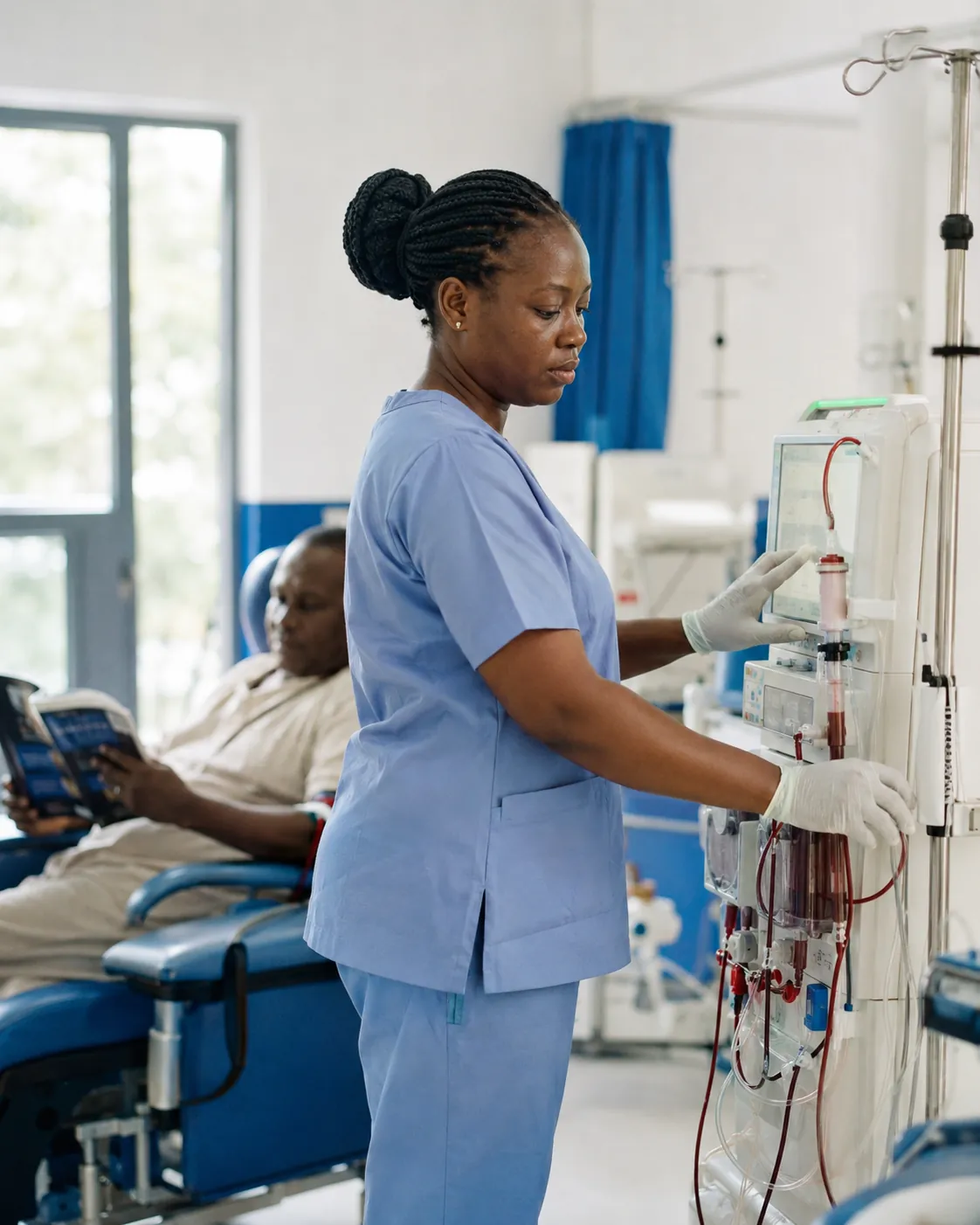
Almost nobody arrives at dialysis expecting it. The overwhelming majority of Nigerian patients who start dialysis learn that their kidneys have failed within weeks of starting treatment, because chronic kidney disease produces almost no symptoms until it is very advanced.
This article sets out how kidney function is actually measured, what the stages mean, and the specific findings that move dialysis from something to think about into something that has to happen now.
How kidney function is measured
Three tests do most of the work, and they answer different questions.
Serum creatinine measures a waste product that healthy kidneys clear. On its own it is a poor guide, because it varies with muscle mass. A large muscular man and a small elderly woman with identical creatinine values have very different kidney function.
Estimated glomerular filtration rate, usually written eGFR, is calculated from creatinine along with age and sex, and it is the number that actually matters. It estimates how many millilitres of blood the kidneys filter per minute. A normal value is above 90.
Urinalysis for protein is the cheapest and most under used of the three. Protein leaking into the urine is often the earliest visible sign of kidney damage, appearing long before creatinine moves at all. A urine dipstick costs very little and detects disease years earlier than a blood test will.
Ultrasound adds the structural picture: kidney size, obstruction, stones, cysts. Small shrunken kidneys indicate long standing chronic damage, which changes the prognosis considerably from a normal sized kidney with acute injury.
The five stages
- Stage 1, eGFR above 90 with evidence of kidney damage such as protein in the urine. Normal filtration, damage present.
- Stage 2, eGFR 60 to 89, mildly reduced with evidence of damage.
- Stage 3, eGFR 30 to 59, moderately reduced. This is where complications begin: anaemia, bone mineral disturbance, rising blood pressure. Most patients still feel entirely well.
- Stage 4, eGFR 15 to 29, severely reduced. Preparation for dialysis or transplant should begin here, including creating a fistula.
- Stage 5, eGFR below 15, kidney failure. Dialysis or transplantation is usually needed.
Note where the preparation belongs. Stage 4, not stage 5. A patient who reaches stage 5 with a fistula already created and matured starts dialysis far more safely than one who starts through an emergency catheter, and the difference in infection risk is substantial.
The specific findings that force the decision
Dialysis is not started at a particular eGFR number alone. It is started when the consequences of kidney failure become dangerous or intolerable. Any of the following will do it.
High potassium. Potassium is normally excreted by the kidneys, and when it accumulates it interferes with the electrical conduction of the heart. A severely raised potassium can cause cardiac arrest with very little warning, and it is the single most common reason for emergency dialysis in Nigeria.
Fluid overload. Fluid the kidneys cannot excrete accumulates, first in the legs and then in the lungs. Pulmonary oedema that does not respond to diuretics is an indication to dialyse, because the alternative is drowning.
Severe acidosis. The kidneys regulate the acid balance of the blood. Severe acidosis that does not correct medically impairs the function of the heart and other organs.
Uraemia. Accumulated waste products cause nausea, vomiting, loss of appetite, intractable itching, confusion, inflammation of the sac around the heart, and a raised bleeding tendency. Uraemic encephalopathy or pericarditis are absolute indications.
Certain poisonings, where the substance can be removed by dialysis.
The distinction that changes everything
There are two entirely different situations that both present as kidney failure, and confusing them causes a great deal of unnecessary despair.
Acute kidney injury is a sudden loss of function, usually over hours to days, caused by dehydration, sepsis, obstruction, drug toxicity, pregnancy complications or major bleeding. It is frequently reversible. Dialysis in this setting is a bridge across the period while the kidneys recover, and many patients come off it entirely.
Chronic kidney disease is a gradual, permanent loss of function over months to years, most commonly from hypertension or diabetes in this population. It does not reverse. Dialysis here is long term unless transplantation is possible.
The two can look identical in the first days. Kidney size on ultrasound, previous blood results if any exist, and the presence of long standing anaemia or bone disease all help distinguish them. Ask your nephrologist which one they think you have, and on what basis.
Slowing chronic disease down
Before stage 5, delay is genuinely achievable, and patients who engage early frequently gain years.
- Rigorous blood pressure control, which is the single most effective intervention
- Tight glucose control in diabetes
- Specific medication classes that reduce protein leakage into the urine
- Stopping nephrotoxic drugs, particularly regular non steroidal anti inflammatory painkillers
- Stopping herbal and traditional preparations of unknown composition, which are a common and under recognised cause of kidney injury in Nigeria
- Dietary sodium, potassium, phosphate and protein management under supervision
- Treating anaemia and bone mineral disturbance rather than ignoring them
Planning honestly
Dialysis in Nigeria is a sustained financial commitment, and families who understand that from the beginning cope far better than those who discover it week by week. Two to three sessions weekly, plus medication, plus periodic blood tests, is an ongoing cost that needs planning rather than improvisation.
Where transplantation is a realistic possibility, it is usually the better long term answer both clinically and financially, and the conversation should happen early rather than after years on dialysis. Ask about it.
Questions worth asking your nephrologist
- What is my eGFR, and what stage does that put me in?
- Is there protein in my urine, and how much?
- Do you think this is acute or chronic, and what is that judgement based on?
- What is the cause, and is any part of it treatable?
- At what point should a fistula be created?
- What can I do that would actually slow this down?
- Am I a candidate for transplantation?
If this is your situation right now
Call the unit. If you are a clinician referring a patient, share the current clinical details so the receiving team can assess the referral before any transfer is arranged.