
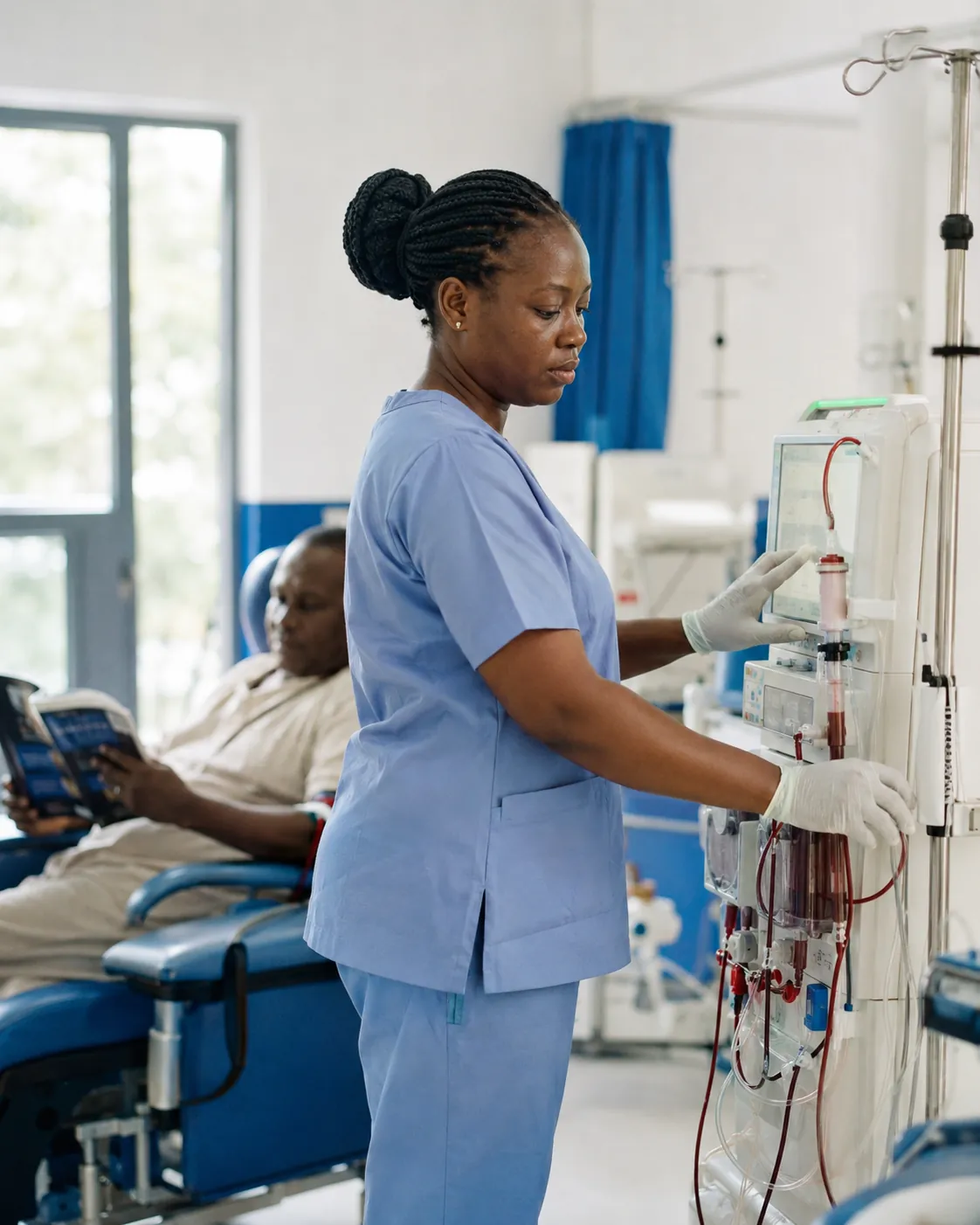
Haemodialysis
Chronic programme dialysis, emergency dialysis and dialysis for patients who are critically ill, in a unit sited alongside intensive care.
Haemodialysis does the work of failed kidneys. Blood is drawn from the body, passed through a filter that removes waste products and excess fluid, and returned. A session typically runs for four hours and, for a patient on a chronic programme, is repeated two or three times a week.
Our unit runs a chronic dialysis programme, takes emergency dialysis referrals, and can dialyse critically ill patients who need other organ support at the same time, because the dialysis unit and the intensive care beds are in the same place.
What happens during a session
You arrive and are weighed. The difference between your current weight and your dry weight, the weight at which your body is neither overloaded nor depleted, determines how much fluid needs to be removed during the session. Blood pressure, pulse and temperature are recorded.
Access is established, either by connecting to your fistula with two needles or by connecting your catheter. The machine is programmed with your prescription: session length, blood flow rate, dialysate composition and the fluid removal target.
For the next three to four hours your blood circulates through the dialyser. You can read, use a phone, eat if permitted, or sleep. Observations are taken every half hour, and staff are watching for the two commonest problems, a fall in blood pressure and cramping, both usually caused by removing fluid faster than the body can tolerate.
At the end, blood in the circuit is returned to you, the needles are removed and pressure applied, and you are weighed again to confirm the target was reached.
Vascular access
Dialysis needs reliable access to the bloodstream, and the type of access has a large effect on both how well dialysis works and how likely you are to get an infection.
An arteriovenous fistula, created surgically by joining an artery to a vein in the arm, is the best long term option. It has the lowest infection rate and the longest life. It takes six to twelve weeks to mature before it can be used, which is why it should be created well before dialysis is expected to start.
A tunnelled catheter in a large vein is used when dialysis is needed immediately or while a fistula matures. It works from the first day but carries a materially higher risk of bloodstream infection, so it is a bridge rather than a destination.
Look after your fistula arm. No blood pressure cuffs, no blood samples, no drips in that arm, and check daily that you can feel the thrill, the buzzing sensation that means it is flowing.
Between sessions
Most of the work of dialysis happens outside the unit. Fluid intake has to be restricted, because everything you drink between sessions has to be removed at the next one, and large gains mean uncomfortable sessions and strain on the heart.
Diet matters more than most patients are told. Potassium, which is high in bananas, oranges, tomatoes, potatoes and many Nigerian staples, can rise to levels that stop the heart between sessions. Phosphate, salt and protein all need managing, and the specifics differ from person to person. A dietary review is part of the programme, not an optional extra.
Never miss a session or cut one short because you feel well. Feeling well between sessions is what dialysis is producing, not evidence that it is unnecessary.
Emergency dialysis
Some patients need dialysis urgently rather than as part of a programme. The usual reasons are a dangerously high potassium level, fluid overload causing breathlessness, severe acidosis, uraemia causing confusion or pericarditis, and certain poisonings.
Our unit accepts emergency referrals at any hour. Referring clinicians should call ahead so that a chair, the nursing staff and the nephrologist are ready when the patient arrives.
Common questions
Does dialysis hurt?
Inserting the needles into a fistula is briefly uncomfortable, similar to a blood test but larger. The session itself is not painful, though cramping and a drop in blood pressure can occur if fluid is removed too quickly, and the staff will adjust the rate if so.
Can I work while on dialysis?
Many patients do. Sessions are scheduled to fit around work where possible, and some patients feel washed out for a few hours afterwards while others do not.
Is dialysis a cure?
No. It replaces part of the function of the kidneys and it is continued indefinitely unless a transplant is possible. It does the clearance and fluid work, but it does not replace the kidney's hormonal functions, which is why other medications are also needed.
Can I have dialysis here while under another hospital's care?
Yes. We take patients whose nephrologist is elsewhere. Bring your dialysis prescription, recent blood results and hepatitis screening status.
Who looks after your relative
Care in the unit is led by our consultant intensivist, with critical care nurses at the bedside continuously and specialist input from nephrology and anaesthesia where the case calls for it.
 Dr Emmanuel NjokuDirector of Critical Care ServicesMeet the team →
What this costs
Cost depends on the level of support actually needed, so we quote rather than publish a rate card. Call the unit and you will be given the current figure, what would change it, and where your HMO cover stands, before treatment wherever the situation allows.
Costs and coverNext step
If you need a bed tonight, call. We will tell you straight away.
The unit is staffed at every hour. Referring clinicians should call before transferring a patient so availability can be confirmed and the team can be ready on arrival.